
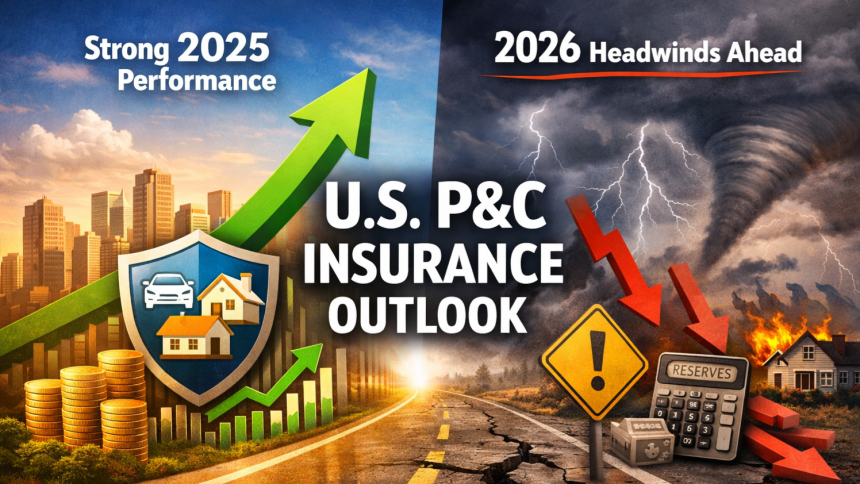
Strong 2025 Performance with 2026 Headwinds Ahead: What’s Next for the U.S. P&C Insurance Industry?
The U.S. property and casualty (P&C) insurance industry delivered one of its strongest performances in more than a decade in 2025. After several years of pricing corrections, underwriting discipline, and investment recovery, insurers experienced improved profitability and stronger balance sheets.
However, as 2026 approaches, the outlook is becoming more complex. While the sector remains financially solid, emerging pressures such as inflation, potential reserve adjustments, catastrophe exposure, and softening pricing trends could challenge carriers.
According to recent insights from AM Best, economic fundamentals remain supportive, but headwinds are building. This article explores what fueled the strong 2025 results and what risks insurers—and policyholders—should watch in 2026.
Understanding the U.S. P&C Insurance Sector
Before diving into performance trends, it helps to understand what the property and casualty sector covers.
P&C insurance includes:
- Auto insurance
- Homeowners insurance
- Commercial property insurance
- General liability insurance
- Workers’ compensation
- Professional liability coverage
Unlike life insurance, which focuses on long-term mortality risk, P&C insurers deal with short- to medium-term risks like accidents, lawsuits, property damage, and natural disasters.
Why 2025 Was a Breakout Year
1. Stronger Pricing Discipline
One of the biggest drivers of 2025 performance was sustained rate increases across personal and commercial lines.
Between 2022 and 2024, insurers raised premiums aggressively to offset:
- Elevated claims costs
- Supply chain disruptions
- Higher auto repair costs
- Increased litigation expenses
By 2025, those pricing actions began to fully earn through the income statement. Loss ratios improved, underwriting results strengthened, and combined ratios dropped to healthier levels.
Key result: Many carriers returned to consistent underwriting profitability for the first time in years.
2. Improved Investment Income
P&C insurers generate income from two main sources:
- Underwriting profit
- Investment income
After years of ultra-low interest rates, rising yields significantly boosted fixed-income portfolios in 2024 and 2025. Since insurers typically invest heavily in bonds, higher rates translated into better returns.
Stronger investment income helped offset volatility from catastrophe losses and social inflation.
3. Better Capital Management
Insurers entered 2025 with improved capital buffers. Many companies:
- Strengthened reserves
- Reduced risky exposures
- Tightened underwriting standards
- Improved reinsurance programs
Rating agencies, including AM Best, noted that capital adequacy across the industry remained strong.
This financial resilience helped carriers absorb catastrophe losses without severe balance sheet stress.
The Economic Strength Behind the Momentum
The broader U.S. economy also played a role in 2025 performance.
- Employment remained stable
- Consumer demand supported premium growth
- Business formation supported commercial lines
While inflation remained elevated compared to pre-2020 levels, it stabilized enough for insurers to recalibrate pricing models.
However, this economic support may not fully shield the industry in 2026.
2026 Headwinds: What Could Slow Momentum?
Although 2025 was strong, several challenges are emerging.
1. Persistent Inflation Pressure
Inflation remains one of the biggest risks.
Even moderate inflation affects:
- Auto repair parts
- Medical costs
- Construction materials
- Labor expenses
Claims severity rises when inflation increases the cost of replacing vehicles or rebuilding homes. If premium growth slows while claims costs continue climbing, underwriting margins may tighten.
2. Potential Reserve Adjustments
Insurance reserves represent funds set aside to pay future claims. If insurers underestimate loss development—especially in long-tail lines like:
- Commercial liability
- Workers’ compensation
- Professional liability
They may need to strengthen reserves.
Reserve adjustments can impact earnings significantly. Even financially strong carriers can see profit volatility if prior-year reserves need correction.
3. Softening Pricing Environment
After several years of aggressive rate increases, competitive pressures are building.
When profitability improves:
- New entrants enter markets
- Competition intensifies
- Rate increases moderate
A “soft market” environment could develop in certain lines, particularly commercial property and auto, where pricing momentum has been strong.
If rates soften before claims costs stabilize, margin pressure may return.
4. Catastrophe Risk and Climate Exposure
Natural catastrophe exposure remains a structural risk.
Severe weather events—including hurricanes, wildfires, and convective storms—continue to produce record insured losses.
Regions like:
- Florida (hurricanes)
- California (wildfires)
- Gulf Coast states
- Midwest storm corridors
remain high-risk zones.
Reinsurance costs also remain elevated, increasing expenses for primary insurers.
5. Social Inflation and Litigation Trends
“Social inflation” refers to rising litigation costs and higher jury awards.
Drivers include:
- Larger liability verdicts
- Expanding definitions of negligence
- Third-party litigation funding
These trends particularly affect commercial liability and umbrella policies.
Even with strong pricing, unpredictable legal environments can create earnings volatility.
What AM Best’s Outlook Suggests
AM Best reports suggest that while the sector remains fundamentally sound, the tone has shifted from strongly positive to cautiously stable.
Key takeaways:
- Capital adequacy remains strong
- Underwriting discipline has improved
- Economic strength supports premium growth
- Headwinds are becoming more visible
In other words, 2026 is not expected to be a crisis year—but it may not match the strength of 2025.
Impact on Consumers and Businesses
For policyholders, what does this mean?
Auto Insurance
Rate increases may slow in 2026, but premiums are unlikely to fall significantly due to persistent repair and medical costs.
Consumers should:
- Compare quotes annually
- Maintain strong driving records
- Bundle policies when possible
Homeowners Insurance
In catastrophe-prone areas, premiums may continue rising. Some carriers may:
- Reduce coverage
- Increase deductibles
- Exit high-risk regions
Homeowners should review coverage limits carefully and consider mitigation improvements.
Commercial Insurance
Businesses may see:
- Stabilizing rates in some lines
- Continued pressure in high-risk sectors
- Greater underwriting scrutiny
Strong risk management practices can improve negotiation leverage.
How Insurers Are Preparing for 2026
Carriers are not ignoring emerging risks. Many are:
- Refining risk selection models
- Leveraging AI for claims analysis
- Expanding catastrophe modeling
- Tightening reinsurance structures
Technological innovation is playing a larger role in underwriting precision and fraud detection.
Companies are also focusing on expense discipline to protect margins if pricing slows.
Investment Market Uncertainty
Another variable for 2026 is financial market performance.
If interest rates decline:
- New bond yields may fall
- Investment income growth could slow
If equity markets become volatile, portfolio values could fluctuate.
Investment strategy will remain critical to overall profitability.
The Bigger Picture: Cyclical Nature of P&C Insurance
The P&C insurance industry is historically cyclical:
- Hard market → Rising prices, strong profits
- Soft market → Increased competition, shrinking margins
2025 reflected the peak of a hard market cycle. 2026 may represent the early stages of moderation.
The key question is whether underwriting discipline holds firm.
Long-Term Outlook Beyond 2026
Despite short-term headwinds, long-term fundamentals remain supportive:
- Growing population
- Expanding asset values
- Increasing business complexity
- Higher risk awareness
Insurance demand is not disappearing. If anything, climate risk and economic uncertainty reinforce the need for coverage.
The industry’s challenge is balancing:
- Competitive pricing
- Adequate reserves
- Catastrophe exposure
- Sustainable profitability
Key Metrics to Watch in 2026
Industry observers should monitor:
- Combined ratio trends
- Reserve development disclosures
- Catastrophe loss frequency
- Reinsurance pricing changes
- Investment income growth
- Regulatory changes
These indicators will reveal whether headwinds remain manageable or intensify.
Final Thoughts
The U.S. property and casualty insurance sector demonstrated remarkable resilience in 2025. Strong pricing discipline, improved investment returns, and better capital management produced one of the best years in over a decade.
However, 2026 introduces meaningful uncertainty.
Inflation pressure, reserve risks, softening pricing, catastrophe exposure, and litigation trends could test underwriting strength. According to AM Best, the sector remains financially solid—but the environment is shifting.
For insurers, the focus will be discipline and adaptability.
For consumers and businesses, awareness and proactive risk management will be key.
The industry is not facing collapse—but it is entering a more nuanced phase.
If carriers maintain underwriting discipline and capital strength, 2026 may not be as strong as 2025—but it can still be stable, sustainable, and strategically important for the future of U.S. insurance markets.